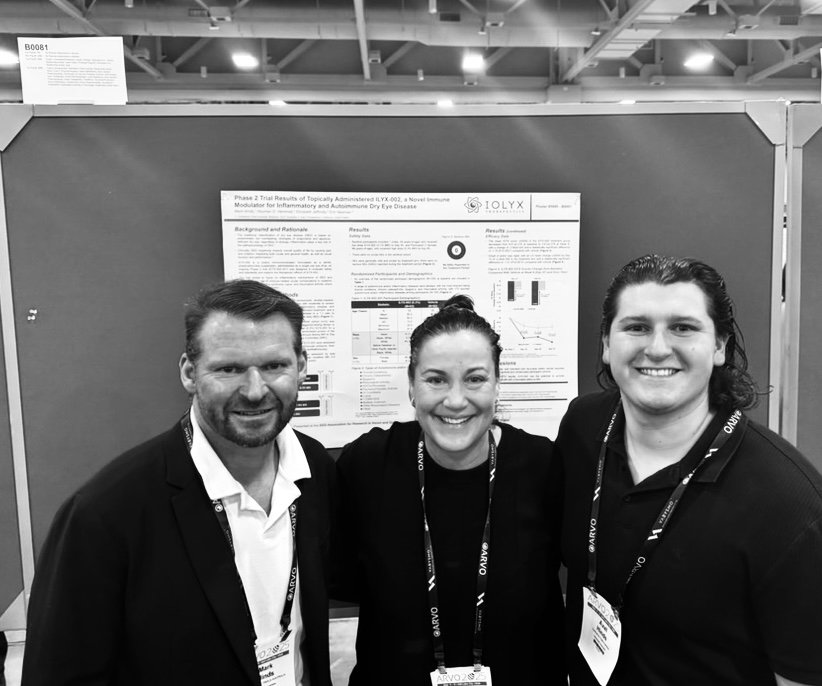
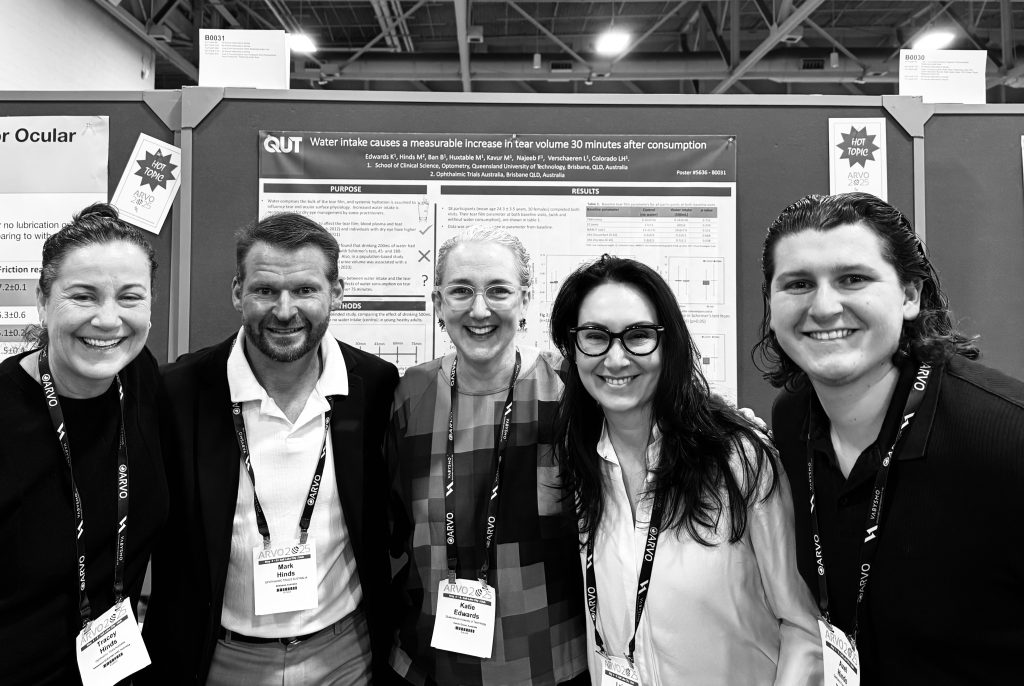
The Association for Vision and Research in Ophthalmology – Salt Lake City – May 2025
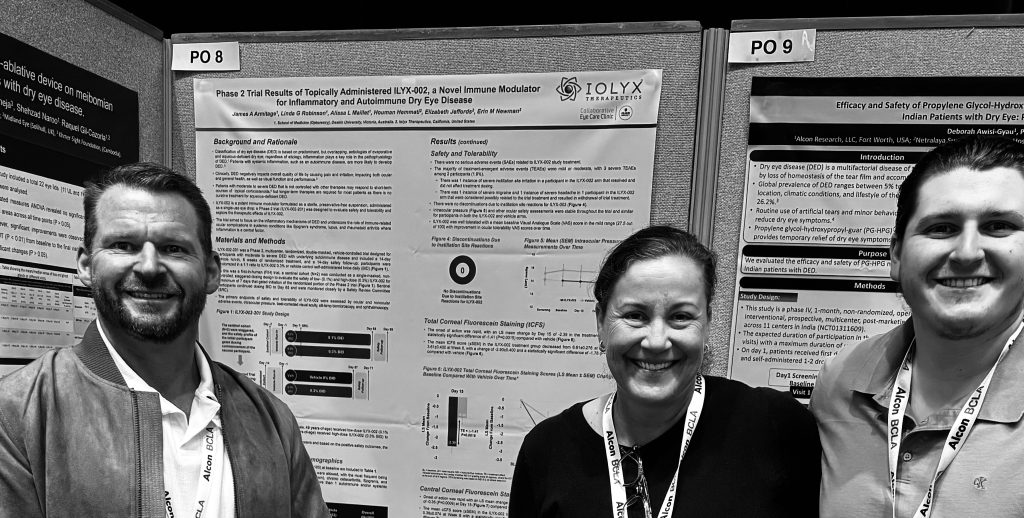
The British Contact Lens Association – Birmingham, UK – 2025
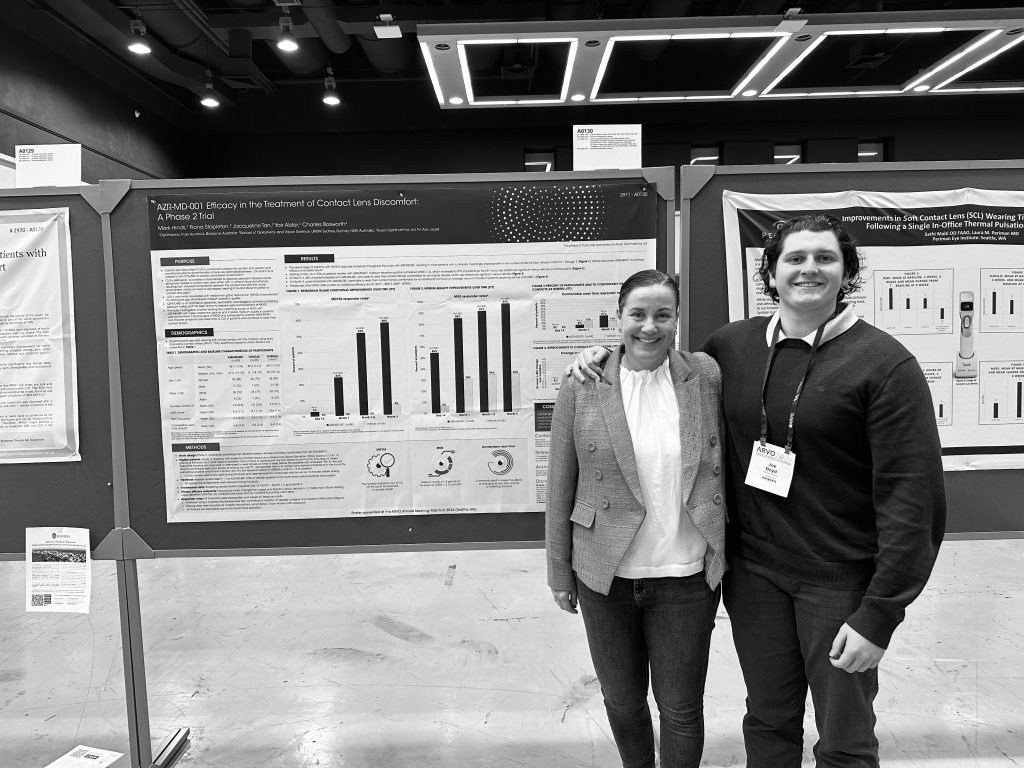
The Association for Vision and Research in Ophthalmology – Seattle – May 2024
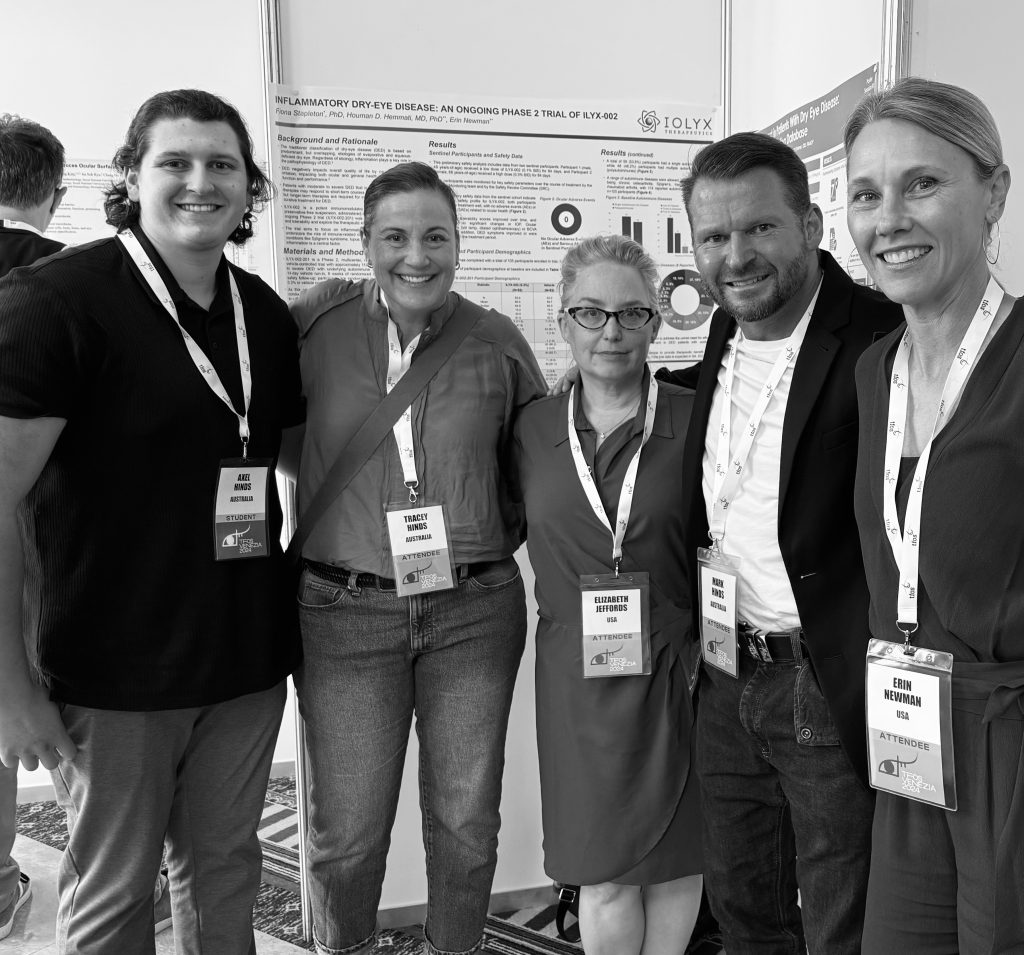
Tear Film and Ocular Surface (TFOS) – Venice Italy – October / November 2024
What We do and Recent Publications
Our Collaborations and Expertise
At Ophthalmic Trials Australia (OTA), we collaborate with leading universities and institutions across Australia, New Zealand, and Canada to support a diverse range of partners, from small biotech startups to large pharmaceutical companies. Sponsors are from around the globe, with the vast majority originating in the USA. Together, we work to raise awareness of advances in solutions for ocular diseases and drive the development of innovative treatments. Through these strong partnerships, we have had the privilege of contributing to numerous peer-reviewed scientific journals, posters, and podium presentations. Some of our published work is referenced below.
Commitment to Rigorous and Ethical Research
Conducting clinical trials requires meticulous assessment and rigorous oversight. Our research is guided by both external Human Research Ethics Committees (HREC) and robust internal governance frameworks, ensuring that all studies are conducted ethically, safely, and with scientific integrity. Our team of ODs, MDs, Specialists, and allied health professionals screens all potential clinical trials to ensure not only a safe clinical trial but one that is effective in our search for solutions for unmet needs.
Comprehensive Clinical Trial Experience
OTA has extensive experience in both therapeutic and device clinical trials, spanning all phases of development—from first-in-human (Phase I) through to post-market assessment (Phase IV). We partner with sponsors to develop first-in-human sentinel dosing protocols, Single Ascending Dose (SAD) and Multiple Ascending Dose (MAD) studies, and safety committee reporting structures. These processes not only identify safety signals but also provide critical insights into efficacy and Mechanism of Action (MOA).
State-of-the-Art Facilities and Efficient Trial Delivery
Our easily accessible, custom-built facilities and cutting-edge equipment enable us to conduct safe and timely research. We deeply respect our sponsors’ investment by delivering safe, ethical, unbiased, and efficient results. Where possible, all testing facilities have redundancy plans with duplicate or triplicate units. Moreover, our pharmacy is equipped with a backup battery power and a secondary generator on site.
Unlike larger organisations such as universities or hospital research settings, OTA benefits from a streamlined management structure. This allows us to expedite trial processes with faster response and turnover times, limited only by external factors beyond our control. This resource-saving advantage of being faster to terminate or faster to finish is one of our advantages.
Sponsor Consultancy and Early-Phase Expertise
At OTA, our experienced team provides specialised consultancy services to biotech and pharmaceutical companies, focusing on Phase I (first-in-human) and Phase II clinical trial development for investigational products (IP) and devices. We expertly navigate regulatory pathways and optimise trial logistics to streamline HREC submissions, ensuring efficient, ethical trial execution in full compliance with Good Clinical Practice (GCP). Our deep expertise in early-phase ophthalmic research helps accelerate sponsors’ IP journey from first-in-human studies to proof of concept with early signal identification.
At OTA, we are proud to have played a key role in pivotal clinical trials that have supported New Drug Applications (NDAs) with the U.S. Food and Drug Administration (FDA). Our contribution to these global programs reflects not only the quality and reliability of our clinical research, but also the strength of Australia as a destination for world-class ophthalmic trials.
By consistently delivering high-quality data, efficient patient recruitment, and strict adherence to international regulatory standards, OTA has been trusted as a partner in trials that directly shaped the evidence base for FDA approval of novel therapies. These therapies now represent new treatment options for patients worldwide—advancing care in areas such as ocular surface disease, retinal conditions, glaucoma, and myopia management.
Our reputation as a leading early- and mid-phase ophthalmic research site ensures that sponsors and CROs look to Australia not just for speed and cost-effectiveness, but for excellence in trial conduct. Each successful NDA we have contributed to reinforces our mission: bringing innovative, sight-saving treatments from the research stage to clinical reality.
Some of Ophthalmic Trials Australia’s Recent Publications & Conference Presentations
REVIEW of OPTOMETRY – December 15, 2025
Frayed Nerves By Kaleb Abbott, Mark Hinds and Paul Karpecki.
Ophthalmic Trials Australia – searching for better treatments for ocular surface pain.
Healio.com Primary Care Optometry News June 18, 2025.
ILYX-002 rapidly improves immune-mediated dry eye disease in phase 2 trial. “What’s remarkable is how fast the effect appeared,” Mark Hinds, principal investigator of the ILYX-002-201 trial, said in the release. “A treatment difference of this magnitude in just 2 weeks is something we normally see only with topical steroids, yet we recorded zero discontinuations for tolerability and no IOP concerns. Better still, the benefit was sustained through week 8, confirming a durable response for patients who have had very few safe options.”
Summary ARVO (The Association for Research in Vision and Ophthalmology) Annual Meeting 2025 Posters (Salt Lake City, Utah, United States)
May 3–8, 2025
ARVO 2025: Phase 2 Trial Results of Topically Administered ILYX-002, a Novel Immune Modulator for Inflammatory Dry Eye Disease. Mark Hinds, Houman Hemmati, Elizabeth Jeffers, Erin Newman.
ARVO 2025: Water intake causes a measurable increase in tear volume 30 minutes after consumption. Katie Edwards, Mark Hinds, Binita Ban, Meagan Huxtable, Madeleine Kavur, Farah Najeeb, Louise Verschaeren, Luisa H. Colorado.
The Ocular Surface Volume 35, January 2025, Pages 15-24
Efficacy and safety of AZR-MD-001 selenium sulfide ophthalmic ointment in adults with meibomian gland dysfunction over six months of treatment: A Phase 2, vehicle-controlled, randomized extension trial
Laura E. Downie, Jennifer P. Craig, Fiona Stapleton, Jacqueline Tan, Lyndon W. Jones, Alison Ng, Mark Hinds, Charles Bosworth, Yair Alster.
Tear Film and Ocular Surface (Venice, Italy) October 30 – November 2, 2024
TFOS 2024: THE EFFECT OF AZR-MD-001 0.5% OPHTHALMIC OINTMENT ON MEIBOMIAN GLAND SECRETION, QUALITY AND COMFORTABLE LENS WEAR OVER 3 MONTHS OF DOSING IN PATIENTS WITH CONTACT LENS DISCOMFORT. Fiona Stapleton1, Jacqueline Tan,1 Mark Hinds,2 Yair Alster,3 Charles Bosworth,3 UNSW Sydney, NSW, Australia,1 Ophthalmic Trials Australia, Brisbane, Australia,2Azura Ophthalmics Ltd, Tel Aviv, Israel3
TFOS 2024: INFLAMMATORY DRY-EYE DISEASE: AN ONGOING PHASE 2 TRIAL OF ILYX-002. Fiona Stapleton1, Houman D. Hemmati2, Erin Newman2.1
School of Optometry and Vision Science, UNSW Sydney, NSW, Australia. 2
Iolyx Australia Pty Ltd, Southbank, VIC, Australia
International Cornea and Contact Lens Congress 2024 (Gold Coast, QLD, Australia)
August 23-25, 2024
ICCLC 2024: AZR-MD-001 Opens Meibomian Glands, Improves
Meibum and Tear Quality Resulting in Increased
Wear Time and Desired Lens Use in Patients With CLD.
Mark Hinds, Fiona Stapleton, Jacqueline Tan, Yair Alster,
Charles Bosworth.
ICCLC 2024: Efficacy in Resolving the Signs and Associated
Symptoms of Contact Lens Discomfort in a
Phase 2 Trial. Mark Hinds, Fiona Stapleton, Jacqueline Tan, Yair Alster,
Charles Bosworth.
Summary ARVO (The Association for Research in Vision and Ophthalmology) Annual Meeting 2024 Posters (Seattle, WA, United States)
May 5–9, 2024
ARVO 2024: AZR-MD-001 Efficacy in Resolving the Signs and Associated Symptoms of Contact Lens Discomfort in a Phase 2 Trial. Mark Hinds, Fiona Stapleton, Jacqueline Tan, Yair Alster, Charles Bosworth.
ARVO 2024: AZR-MD-001 Improved Corneal and Conjunctival Damage in Patients with CLD and MGD. Charles Bosworth, Mark Hinds, Eric Kassel, Yair Alster.
ARVO 2024: AZR-MD-001 Ophthalmic Ointment Opens Meibomian Glands, Improves Meibum Quality, and Tear Film Stability Over 3 Months of Dosing in Patients with Contact Lens Discomfort. Fiona Stapleton,Jacqueline Tan, Mark Hinds,Yair Alster, Charles Bosworth.
ARVO 2024: Safety and Efficacy of Topical AZR-MD-001 for the Treatment of Meibomian Gland Dysfunction in a 6-Month Study. Jacqueline Tan, Fiona Stapleton, Laura E. Downie, Yair Alster, Charles Bosworth, CELESTIAL Study Group.
ARVO 2024: AZR-MD-001 Improved Tear Film Stability and Ocular Symptoms in Patients with Meibomian Gland Dysfunction: 6-Month Results. Joshua C. Teichman,Mark Hinds, Laura E. Downie, Yair Alster, Charles Bosworth, CELESTIAL Study Group.
ARVO 2024: Sign and symptom improvement rates among MGD patients following treatment with AZR‑MD‑001 for 6 months. Julie Schallhorn, Lyndon W. Jones, Alison Ng, Yair Alster, Charles Bosworth, CELESTIAL Study Group
ARVO 2024: AZR-MD-001 Opens Meibomian Glands and Improves Meibum and Tear Quality, Resulting in Increased Lens Wear Time in Patients With CLD. Lyndon W. Jones, Julie Schallhorn, Fiona Stapleton, Yair Alster, Charles Bosworth.
ARVO 2024: Validity of the Contact Lens Dry Eye Questionnaire-8 (CLDEQ-8) and its comprehensiveness in assessing disease impact after the widespread adoption of digital media in patients with Contact Lens Discomfort (CLD) and concomitant Meibomian Gland Dysfunction (MGD). Robin L. Chalmers, Yair Alster, Charles Bosworth.
International Society for Contact Lens Research (ISCLR) 2024: A Patient Reported Outcome Measure for Contact Lens Discomfort Sensitive to Therapeutic Intervention in Wearers with Signs of Meibomian Gland Dysfunction. F. Stapleton, R. Chalmers, M. Hinds, J. Tan, Y. Alster, C. Bosworth
(American Society of Cataract and Refractive Surgery) ASCRS2023: AZR-MD-001 Efficacy in Resolving the Signs and Associated Symptoms of Meibomian Gland Dysfunction (MGD): Phase 2 Responder Status. Lisa M. Nijm, Jennifer Craig, Mark Hinds,Yair Alster, Charles Bosworth; The CELESTIAL STUDY Group.
ASCRS2023: AZR-MD-001 Efficacy in Restoring Gland Function and Improving Signs and Ocular Symptoms of Meibomian Gland Dysfunction (MGD): A Phase 2 Trial. Preeya K. Gupta, Laura E. Downie, Mark Hinds, Yair Alster,Charles Bosworth; The CELESTIAL STUDY Group.
(American Academy of Optometry) AAOPT 2023: Safety and Efficacy of Topical AZR-MD-001 for the Treatment of Meibomian Gland Dysfunction: Report of the 6-Month Study Results. Fiona Stapleton, Laura E. Downie, Mark Hinds, Yair Alster,Charles Bosworth; The CELESTIAL STUDY Group.
AAOPT 2023: Sign and Symptom Improvement Rates Among MGD Patients Following 6 Months of Treatment With AZR‑MD‑001. Lyndon W. Jones, Jennifer P. Craig, Mark Hinds, Yair Alster, Charles Bosworth, Alison Ng; The CELESTIAL STUDY Group.
(American Academy of Ophthalmology) AAO 2023: Resolutions of Signs and Symptoms of Meibomian Gland Dysfunction Following 6 Months of AZR-MD-001 Treatment vs. Vehicle: A Randomized Study. Joshua C. Teichman, Lisa M. Nijm, Jennifer P. Craig, Mark Hinds, Yair Alster, Charles Bosworth; The CELESTIAL Study Group.
The Ocular Surface Volume 29, July 2023, Pages 537-546
Efficacy and safety of AZR-MD-001 selenium sulfide ophthalmic ointment in adults with meibomian gland dysfunction: A vehicle-controlled, randomized clinical trial.
Stephanie L. Watson, Lyndon. Jones, Fiona Stapleton, Mark Hinds, Alison Ng, Jacqueline Tan,
Yair Alster, Charles Bosworth, Omer Rafaeli, Venita DePuy, The CELESTIAL STUDY Group.
(The Association for Research in Vision and Ophthalmology) ARVO 2023: AZR-MD-001 efficacy in resolving the signs and associated symptoms of meibomian gland dysfunction (MGD) in a phase 2 trial: responder status analysis. Lisa M. Nijm, Jennifer P. Craig, Mark Hinds, Yair Alster, Charles Bosworth; The CELESTIAL STUDY Group.
ARVO 2023: AZR-MD-001 restores gland function and improves signs and ocular symptoms of meibomian gland dysfunction (MGD). Preeya K. Gupta, Laura E. Downie, Mark Hinds, Yair Alster, Charles Bosworth; The CELESTIAL STUDY Group.